Tai Chi Classes in Croydon
Tai Chi Classes in Croydon

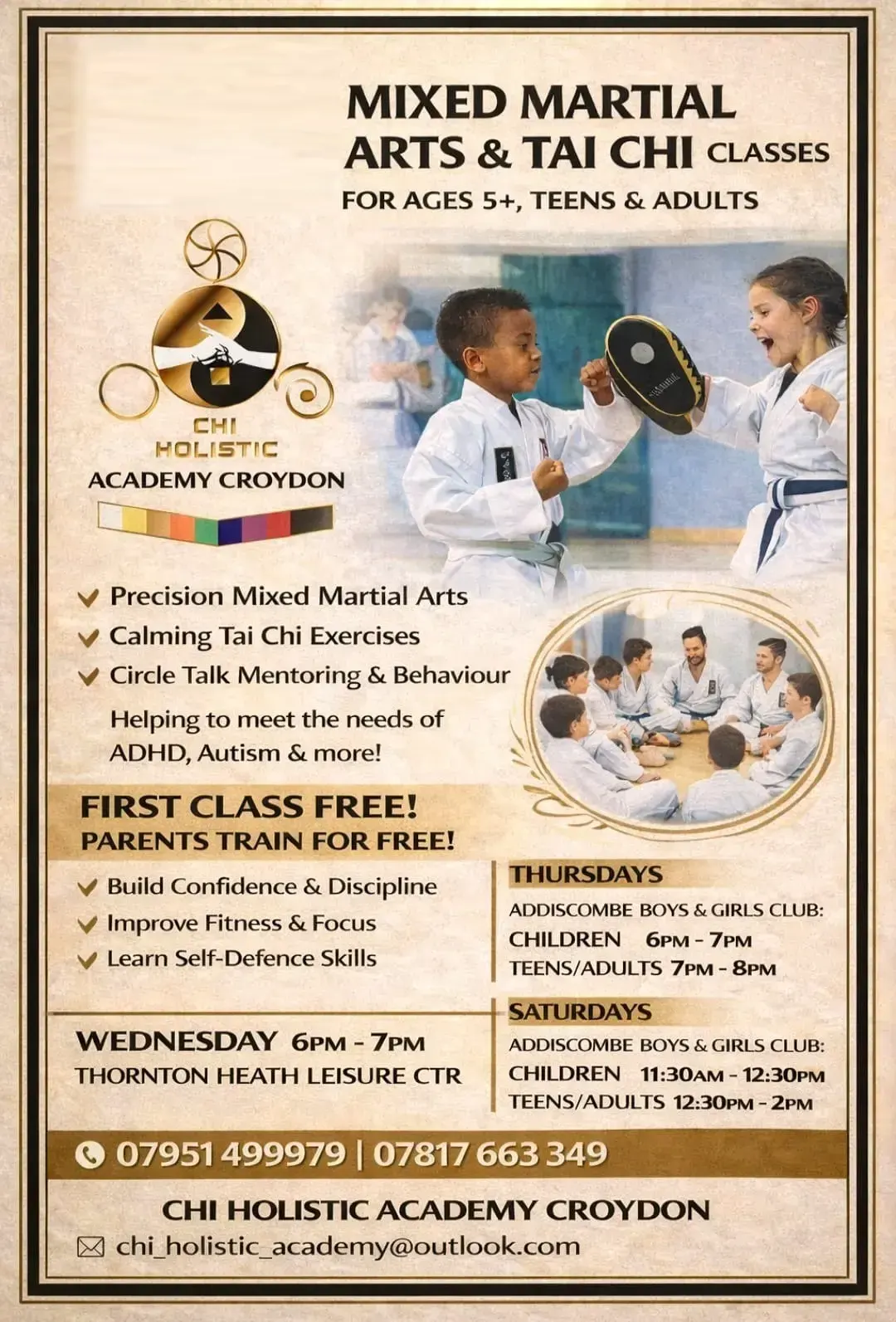
Chi Holistic Academy delivers tai chi classes in Croydon for beginners, seniors, and adults. The academy operates full-day sessions from 9 AM to 3 PM during half terms and summer holidays. Classes focus on balance improvement, flexibility training, and stress reduction through structured tai chi practice. Sibling discounts available for families enrolling multiple participants.

Tai Chi Training at Chi Holistic Academy
Chi Holistic Academy provides tai chi lessons in Croydon with qualified instructors and structured progression systems. Sessions run 6 hours daily during school holiday periods, offering extended practice time compared to standard 1-hour weekly classes. The academy operates as an institution in South London, delivering beginner tai chi classes, adult training sessions, and senior-focused programmes. Private tai chi lessons provide personalised instruction for individuals requiring customised progression pacing or movement modifications.
Tai Chi Classes Croydon
Beginners Tai Chi Classes Croydon
Beginner tai chi classes teach 8 fundamental poses and 12 basic transitions over 8-12 weeks. According to Shanghai University of Sport research from 2020, beginners show measurable balance improvement after 12 weeks of twice-weekly tai chi practice. Classes progress from stationary poses to flowing sequences, with Chi Holistic Academy structuring beginner lessons at 40% stance work and 60% movement practice.
What beginners learn?
Horse stance, bow stance, and empty stance positioning form the foundation of tai chi training. Weight shift exercises between legs develop balance awareness whilst arm coordination with lower body movement builds full-body control. Breathing synchronisation during motion creates the mind-body connection central to tai chi practice. Single-movement repetition establishes muscle memory before progressing to linked sequences.
Tai chi lessons for beginners exclude high-impact movements. No jumping, fast directional changes, or high kicks occur during early training weeks. This gradual progression protects joints whilst building strength and flexibility simultaneously.
Tai Chi Classes for Seniors
Tai chi classes for seniors reduce fall incidents by 50% according to Oregon Research Institute research published in JAMA Internal Medicine in 2018. Senior-focused sessions emphasise balance exercises, joint flexibility, and controlled weight transfers. Tufts University research from 2017 shows seniors practising tai chi twice weekly for 24 weeks achieve 47% improvement in balance test scores compared to control groups.
Tai chi balance exercises for elderly participants include single-leg standing holds progressing from 10 to 45 seconds. Heel-to-toe walking patterns improve linear balance whilst lateral weight shifts with arm coordination develop side-to-side stability. Controlled lowering movements strengthen leg muscles without impact stress. Circular stepping patterns enhance spatial awareness, reducing fall risk in daily activities.
Tai chi balance exercises for seniors target four key systems: Inner ear balance function processes head position changes. Body position awareness allows movement without visual confirmation. Lower body strength in quadriceps and calves supports weight transfers. Core stability maintains posture during directional changes.
Modified intensity options accommodate varying mobility levels. Chair-supported standing poses provide stability for those with balance concerns. Shortened hold times of 15-20 seconds suit individuals building strength. Reduced hip and knee bending range protects sensitive joints. Partner-assisted transitions offer support during challenging movements.
Adult Tai Chi Classes
Adult tai chi classes combine physical training with stress reduction. American Heart Association research from 2021 shows tai chi practice lowers cortisol levels by 21% after 8 weeks of regular training. UCLA research from 2020 reports adults practising tai chi 3 times weekly show 38% reduction in stress scores on psychological assessments.
Sessions include 20-minute warm-ups with joint rotations, 30-minute form practice, 15-minute balance exercise sets, and 10-minute breathing cooldown periods. This structure balances physical conditioning with mental relaxation techniques.
Tai chi for stress relief activates the parasympathetic nervous system during slow breathing. This activation reduces the fight-or-flight response, lowering heart rate during practice. Decreased anxiety develops through mindfulness focus on present-moment movement. The combination of physical activity and meditative concentration creates dual stress-reduction pathways unavailable in purely physical or purely mental exercises.
Private Tai Chi Classes
Private tai chi classes provide one-on-one instruction with customised progression pacing. Private lessons include form correction, personalised movement modifications, and accelerated skill development compared to group training. Sessions run 45-60 minutes with higher repetition counts for skill reinforcement.
Private tai chi lessons include individual flexibility and balance assessment at the start. Custom pose modifications address physical limitations or injury recovery needs. Real-time correction of hand positioning and weight distribution improves technique faster than group settings allow. Personalised home practice plans extend learning between sessions. Focused training on specific goals such as balance, flexibility, or stress reduction maximises individual outcomes.
Private tai chi classes benefit individuals recovering from injuries requiring movement adaptation. Beginners wanting faster progression before joining group classes receive accelerated instruction. Advanced practitioners refining techniques gain detailed feedback. Seniors with mobility restrictions access modified poses unavailable in standard group formats.
Tai Chi Exercises for Balance
Tai chi exercises for balance improve stability through weight shifting and single-leg standing. Harvard Medical School research from 2019 shows tai chi training reduces fall risk in older adults by 43% through improved balance and coordination. Each balance pose holds for 30-60 seconds, progressively increasing duration as stability improves.
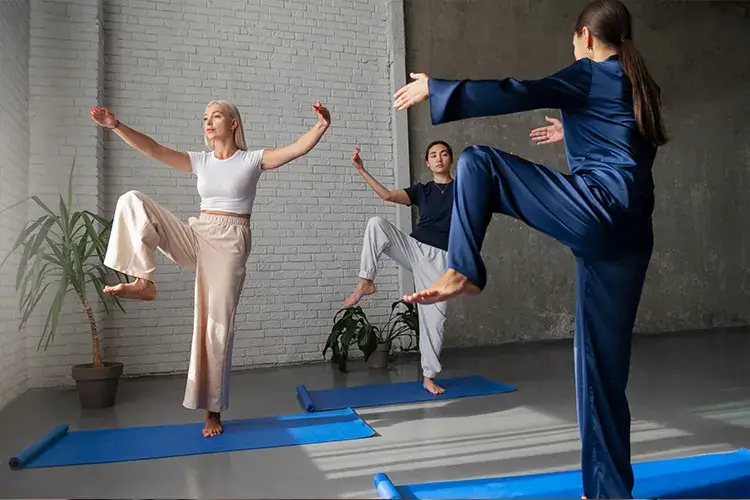
Tai chi poses for balance include white crane spreads wings, combining single-leg standing with arm extension. Brush knee and push develops weight transfer with stability through repeated directional changes. Single whip trains lateral balance with arm coordination during wide stance positions. Cloud hands creates continuous weight shifting between legs whilst maintaining upright posture.
Tai chi for balance trains the vestibular system in the inner ear, processing head position during movement. Proprioceptive awareness develops body position sense without visual confirmation. Lower body muscle strength supports extended standing on single legs. Core stability maintains posture during directional changes and weight transfers.
Tai Chi Exercises for Flexibility
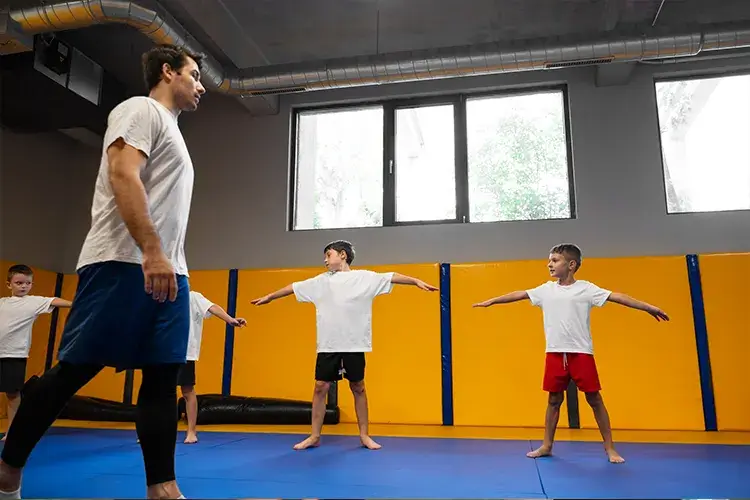
Tai chi exercises for flexibility improve joint range of motion by 18-23% after 12 weeks according to Hong Kong Polytechnic University research from 2019. Flexibility exercises in tai chi include hip circles in horse stance with 20 rotations per direction. Shoulder rolls with arm extensions increase upper body mobility. Torso twists with rooted lower body develop spinal rotation. Ankle rotations during single-leg balance strengthen foot stability. Spine movements in wave patterns improve vertebral flexibility. Wrist circles during arm transitions maintain hand and forearm mobility.
Tai chi combines flexibility development with functional balance training in the same movement. Joint mobility increases through repeated patterns rather than static stretching. This dynamic approach builds flexibility whilst maintaining strength and coordination simultaneously.
Slow Movement Exercises
Slow movement exercises in tai chi take 3-6 seconds per motion compared to 1-2 seconds in regular exercise. Beijing Sport University research from 2018 shows slow exercise movement increases muscle activation time by 240% compared to fast movements, building strength without impact stress.
Benefits of slow exercise movement include greater awareness during motion, allowing practitioners to identify form errors whilst moving. Improved control in stabiliser muscles develops through extended activation periods. Reduced injury risk results from controlled force application. Enhanced mind-body connection forms through movement mindfulness. Lower cardiovascular stress benefits seniors with heart conditions who require gentle exercise options.
Slow movement exercises allow practitioners to identify and correct form errors during motion rather than after completion. Tai chi uses 4-5 second transitions between poses, activating muscles for extended periods without rest intervals between movements. This sustained activation builds endurance and strength simultaneously.

Why Choose Chi Holistic Academy For Tai Chi Classes in Croydon?
Chi Holistic Academy meets quality standards as facility. Structured holiday programmes provide extended practice time unavailable in weekly classes.
Regsitered Institution
Our educational registration means we meet tough standards for child protection, instructor qualifications, and program quality that typical schools don't maintain.
Complete Approach
We work on physical fitness, mental development, character building, and social skills - not just fighting techniques.
Safe Training Environment
Our large facility gives plenty room for safe training, with proper equipment and safety rules in place.
Professional Instructors
All instructors have proper qualifications, pass background checks, and keep learning about both Tai Chi and child development.
Associations



Book Tai Chi Classes in Croydon
Chi Holistic Academy delivers tai chi classes in Croydon with beginner instruction, senior modifications, and adult stress-reduction training. Our academy provides structured sessions during school holidays with 6-hour practice blocks from 9 AM to 3 PM.
Available sessions include beginner tai chi classes with 8-12 week progression systems. Tai chi classes for seniors focus on balance and flexibility development. Adult tai chi classes emphasise stress reduction alongside physical training. Private tai chi lessons offer one-on-one personalised instruction for accelerated learning or specialised needs.
Enrolment benefits include extended daily practice time unavailable in standard weekly classes. Qualified instructor supervision ensures proper form development. Safe, nurturing environment supports learning for all ages. Sibling discounts reduce costs for families enrolling multiple participants.